How was I going to approach this task, how would I display my ideas, would it even work? Naturally this is all part of the scaffolded journey. I eventually found a starting point and went for it. This involved using Bloom's Revised Taxonomy (Anderson, 1990.) as a guide.
I began with Understanding. This presented the questions:
- What exactly is Bloom's Revised Taxonomy and how can it link in with Learning Engagement Theory?
- What is Learning Engagement Theory and who is Shneiderman?
- Why didn't it work?
- What would I change next time to ensure it does work?
- How effective is this really?
Working collaboratively is certainly something I will encourage in the classroom. Old ideas grow into new ideas and you support and push each other. It is definitely a valuable learning tool. By using ICTs collaboratively in and out of the classroom the possibilities for are endless.
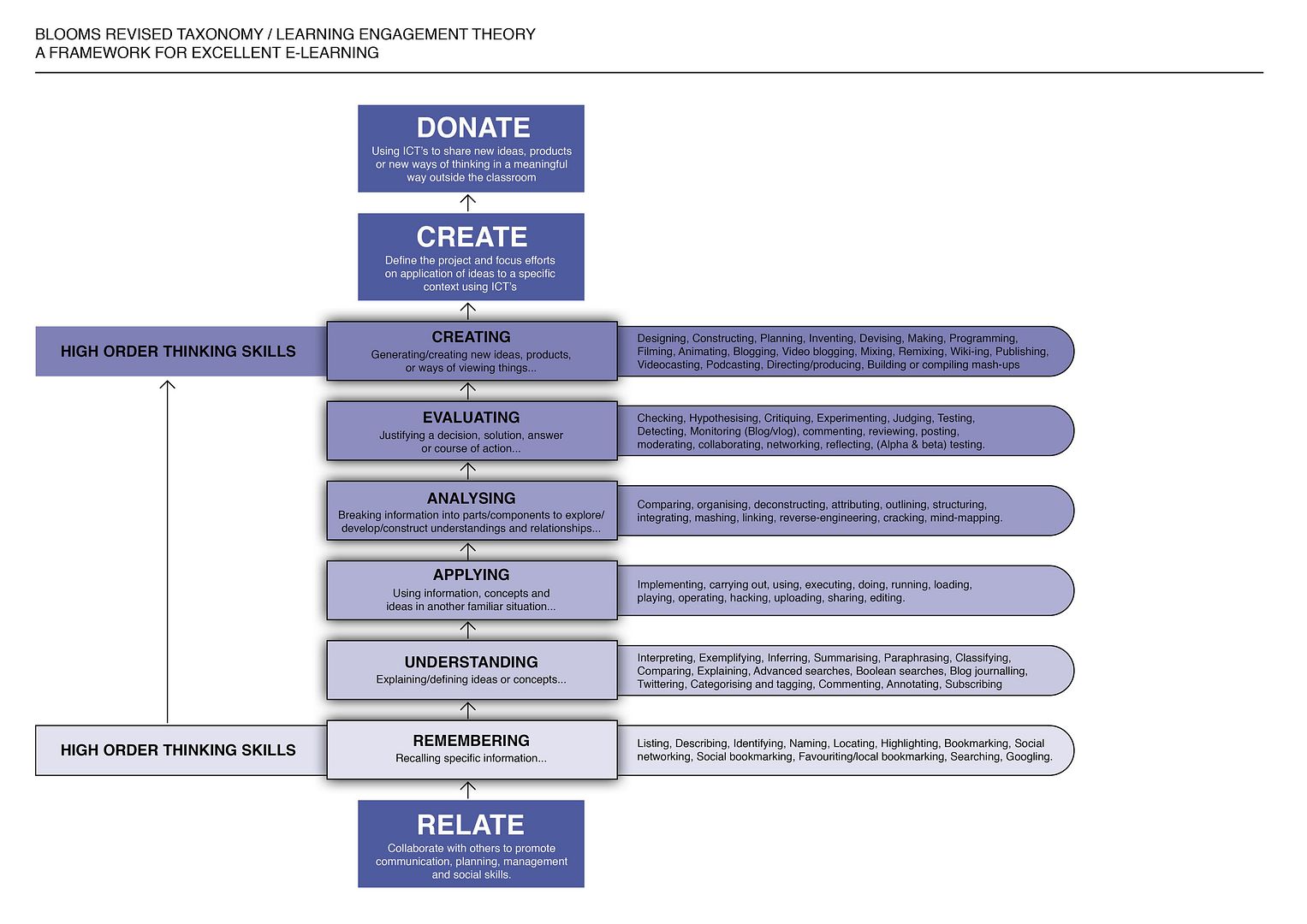
Firstly I experimented with making my framework very linear (See Diagram 1). Visually this didn't look right because learning is so much more fluid. A good example of this is the way I approached this task. I went from understanding, up to creating and back down to analysing and evaluating. No two learners are the same and this framework needs to support all learners at every stage of their journey whether that's up or down, left or right, or moving around levels of thinking in circles.
 |
| Diagram 1 - To view larger click here |
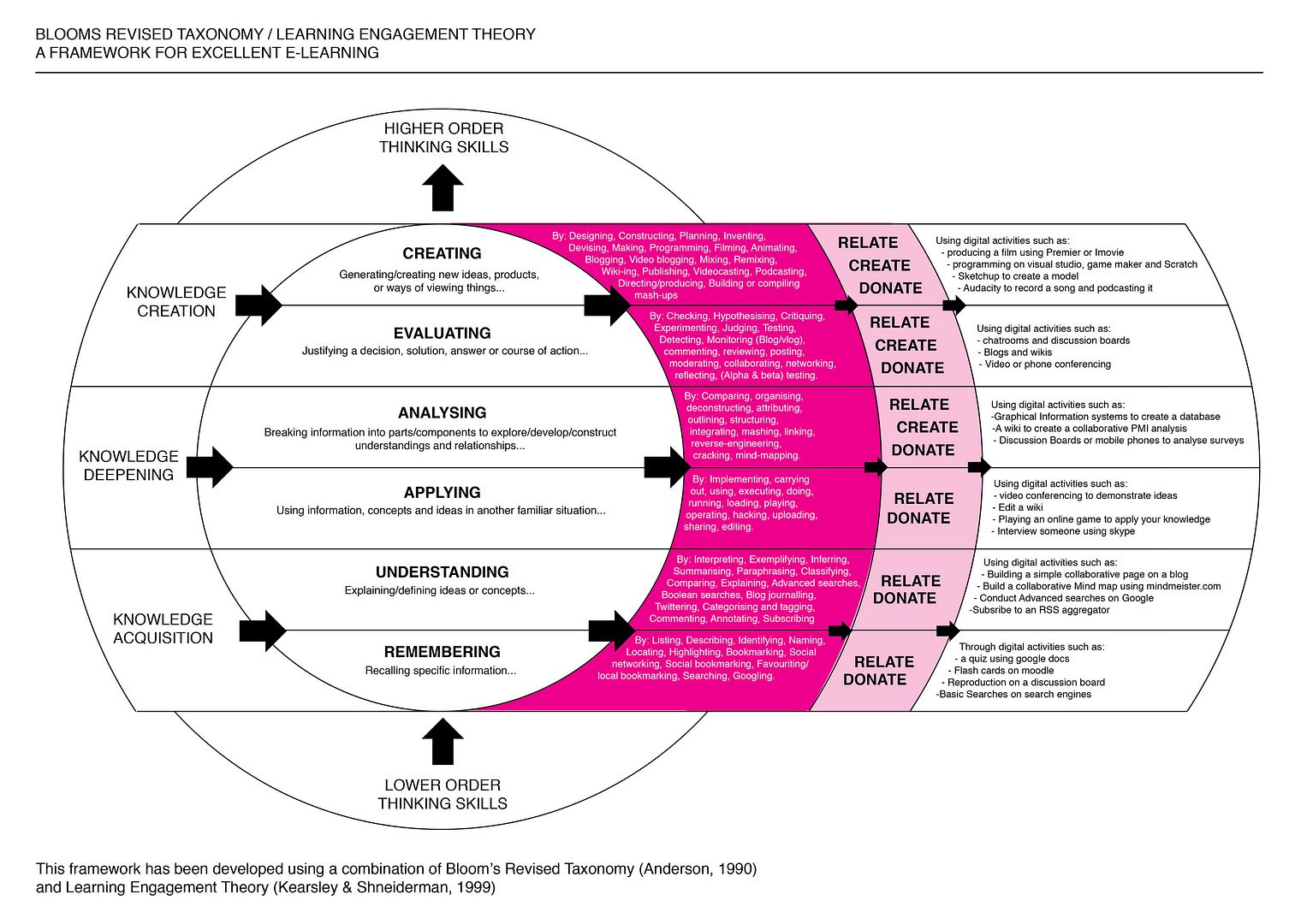
My next approach started with a more circular motion to cater for the different ways students scaffold their learning (Diagram 2). It's still important to create that hierarchy from lower order thinking to higher order thinking. The ultimate goal is to get all students to use higher order thinking skills. I guess this is why it is so hard to build a framework, there are so many things to take into consideration.
 |
| Diagram 2 - To view larger click here |
This is where it became tricky when I tried to incorporate Learning Engagement Theory. Bloom's Revised Taxonomy (Anderson, 1990.) creates the structure to support learners at each stage but it's the Learning Engagement Theory that is going to put this framework into the context of a 21st century learning environment. To make this amalgamation clear I wanted to make my framework very easy to understand. The left hand side is all about Bloom's, while the right hand side shows how this theory can be taken into a 21st century eLearning context. For example moving left to right students can learn using ICTs to:
CREATE a new product by BUILDING a model using SKETCHUP.
The left hand column determines the level of thinking, the next column determines the action and then the final column suggests an ICT to execute the thinking and apply it to a real world context.
Other examples are:
JUSTIFY your decision by POSTING comments on a BLOG
ANALYSE... by DECONSTRUCTING, COMPARING etc through a PMI in a GROUP WIKI
Another element that is critical to building a successful eLearning framework is including the principles 'relate-create-donate' (Kearsley and Shneiderman, 1999.). Each of the digital activities can be executed in a group or maybe just the evaluation is the collaborative effort. Notice I have only put 'create' in the top 3 levels of thinking. Students can definitely 'relate' at any thinking level and 'donate' at any thinking level but I don't think it is until the higher order thinking begins that 'create' can really happen.
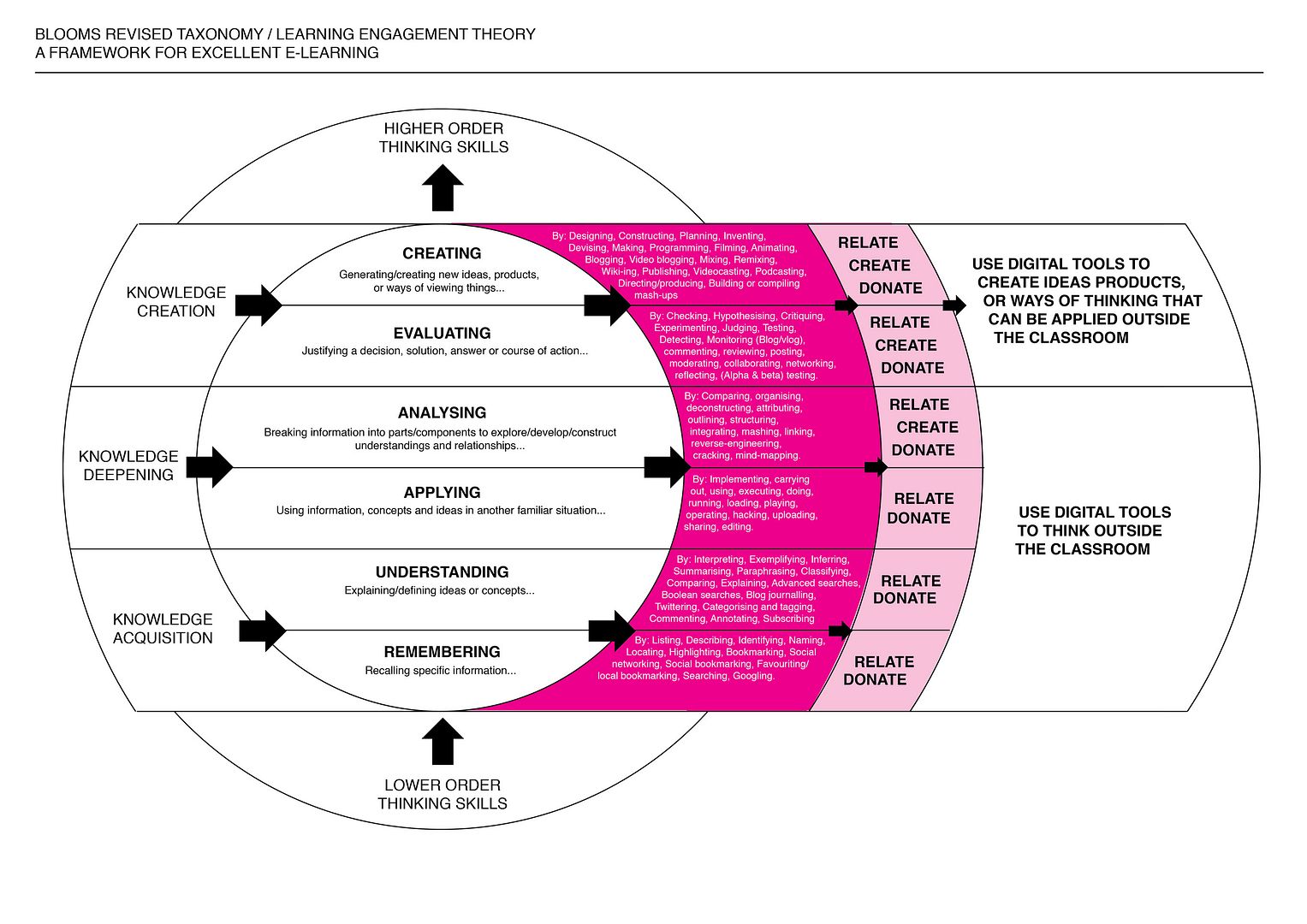
I also designed a more simplified model (Diagram 3). This framework doesn't demonstrate ICTs that can be used it simply gives the action and suggests through the use of ICTs that it be meaningful in a context outside the classroom.
 |
| Diagram 3 - To view larger click here |
I'm sure as I progress through this course I will find flaws with my framework and will need to rework it to fit with my new knowledge. At this stage of the course (It's only week 2) I think it encapsulates all the principles to create a successful eLearning design. My framework supports each level of learning, encourages higher order thinking and places students into contexts where they are constantly having to bounce ideas of one another through ICTs.
Kearsley, G., & Shneiderman, B. (1999) Engagement Theory: A Framework for Technology-Based Teaching and Learning. Retrieved March 15, 2011, from http://home.sprynet.com/~gkearsley/engage.htm

No comments:
Post a Comment